
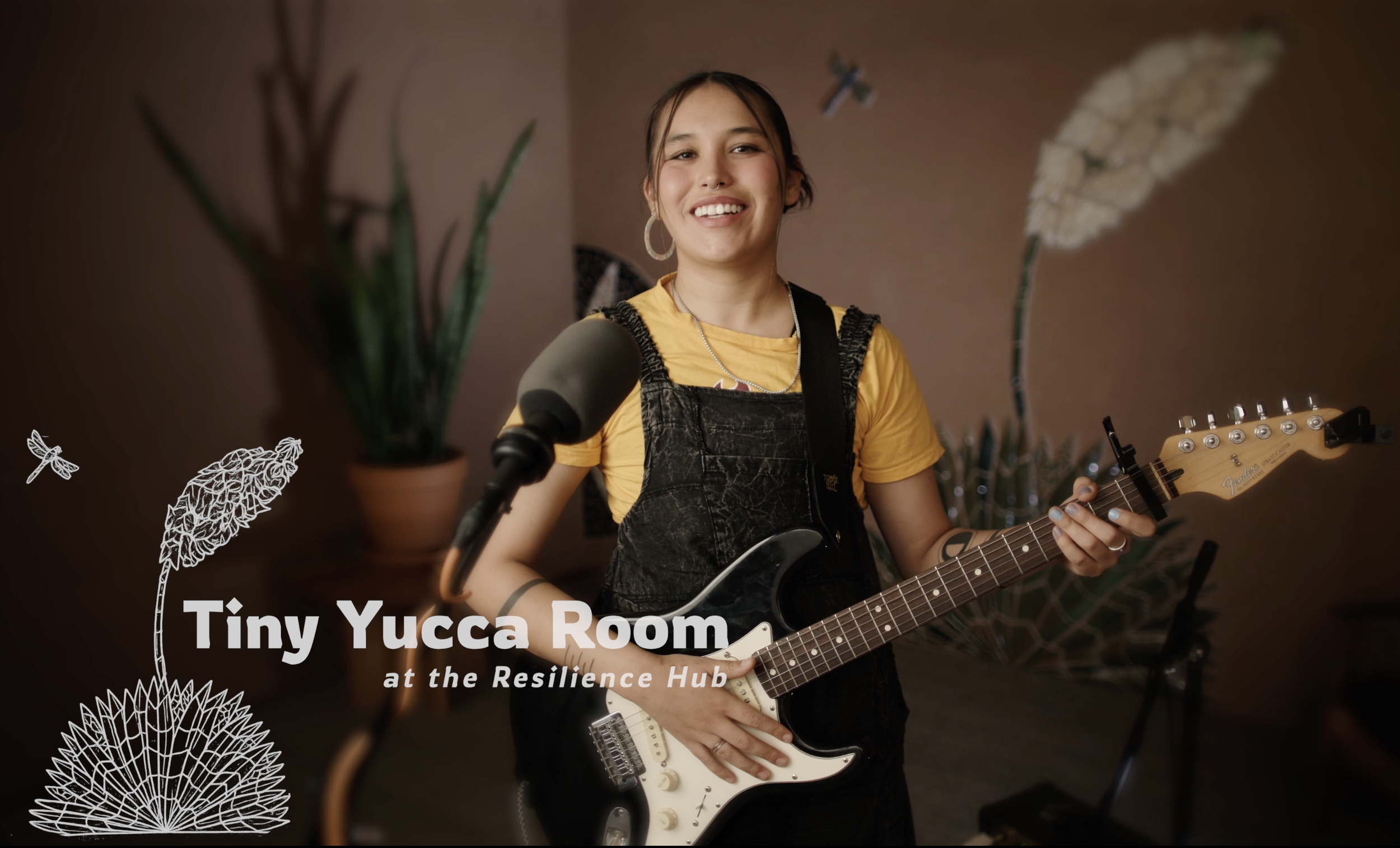
Written Interview Version by Ari Tenorio - Edited for length and clarity
Ailani:
Hi, I’m Ailani, I’m from Santa Clara Pueblo. I’m a 22 year old singer, songwriter, producer, musician, person. And today I'll be playing some songs.
The first song I'm going to play is a song called “Stop”. It's from my album Mortified from 2022 and it's a song about mental health struggles and overall themes of just struggling with depression and anxiety and just kind of wanting it to move to the side so you can continue on your path. So, um yeah, this is “Stop”.
TFIIW:
Can you share what you recall as your first musical memory?
Ailani:
My first musical memory was actually my grandma ordered - she loves ordering from magazines - and she ordered me a tiny little like nylon string guitar and it was for like children and I remember I didn't know how to play it and I really want to just know how. I didn't know you had to learn and so I came up with this thing where you just hit the guitar really
fast and go up and down and I told my grandma I said, “look I'm playing in reverse” cause it sounded like guitar playing backwards and so that was my first memory with an instrument.
TFIIW:
What are your current inspirations as an artist?
Ailani:
Currently, right now, I'm so inspired by KP from Black Belt Eagle Scout. I am about to go on tour with her and she's just an amazing person and mentor and her resilience and artistry is like truly, truly impressive to me. It's been such an honor to work with her and be a fellow indigenous woman guitarist and songwriter in her presence. I feel like I have so much to learn from her and I've been listening to her music so much and I find it so inspiring lately.
TFIIW:
That’s exciting! Do you have a tour stop you’re really looking forward to?
Ailani:
The tour stop I'm most excited for is probably Chicago. I think it's going to be really fun. I've never been there - it's like one of the only cities I haven't been to yet - so I'm really excited to “rock out” as Avril Lavigne said once in 2000-something.
TFIIW:
Speaking about tours, how do you go about marketing yourself - for upcoming tours or when you release music?
Ailani:
I am so bad at marketing myself. I don't - that's my marketing strategy. I just don't post, I don't email, I don't talk to anybody, and I stay hidden until someone is like, "Hey..” It’s terrible.
Ailani/TFIIW Team Laughter
My mysterious ominous marketing has been doing wonders. Leave them being like, "Who's this? Who's this person?" Yeah. The lore of Ailani? Unknown.
TFIIW:
How are you liking this impromptu recording space set up?
Ailani:
It is so nice being here today at the Resilience Hub. It's such a lovely space and it holds people so warmly and the space is put together so well. I'm very grateful for the Future is Indigenous Women, I’ve worked with them many times over the last 3 years performing as well as doing filming and showing up to markets and I'm just really grateful for the empowerment and the support for indigenous artists and native people at the Future is Indigenous Women, New Mexico Community Capital and here at the Resilience Hub.
TFIIW:
Do you want to expand on that a little and talk about what types of support Indigenous artists need from community organizations?
Ailani:
I just feel like nurturing is the word I want to use most when it comes to native artists and what they need. It's like seeing what they do and just trying your best to uplift that. I feel like you all do a really good job of that and just finding out what resources someone may need.
It really differs depending on the artist and I feel like obviously some artists need more support and more funding and other artists need maybe just a space to do their work or other things. I feel like y'all do a really good job at providing that and going on artist to artist basis. I just feel like every artist is different and I feel like it's just really important to acknowledge what they specifically need or want to further uplift their career. So that's all.
Ailani:
This song is called Till The Morning and it's from my recent album, The Unshakable, which came out in 2025. It's the last song of the album and it's about being obsessed with your partner to the point where you miss them. Even if you're sleeping by them you want them to dream about you while you're asleep and you want to dream about them. Um, yeah. This is Till the Morning.
TFIIW:
Aside from the tour, what’s next in store for you?
Ailani:
I'm really looking forward to just creating more music. Creating more songs and I think really changing how I perform. I've been performing with backtracks for a while, I think it’d be really cool - and it's intriguing to me - to possibly have a band if not somewhat of a band. I think just getting more into performance and also with my new songs kind of catering that towards live
shows. All my past stuff was very DIY bedroom stuff so it wasn't really, I mean it was during the pandemic a lot of it, so I wasn't really looking to perform them. And yeah, just getting a lot more equipment and a lot more things going on to really liven up my live shows.
TFIIW:
Are there any musicians that are inspiring your process to create with live performances in mind?
Ailani:
Lately I've been really into Still Woozy. I really like how experimental and unique his sound is. I think he definitely inspires me to want to add more odd flavor to a song and little quirky sounds and little quirky adlibs and ideas. I also am constantly inspired by Hosier. I feel like he is a really talented musician of our times and I feel like I really gravitate towards his lyrics. I feel like having really vulnerable, detailed, poetic lyrics are really beautiful and really inspiring to me and I want to definitely do more of that. I'm not going to be as fancy-shmancy but I'll definitely work on that always.
TFIIW:
Can you share your thoughts on the future of Indigenous creatives and the recent boom of representation in mainstream media?
Ailani:
I think I have to kind of go based off of my own experience and kind of like what I want for myself and I do think that it could be broad enough to apply to other native artists. I think after Reservation Dogs there's obviously been a lot of Indigenous actors, musicians, artists being put into the mainstream and I think that's really awesome. For the future, I really want it to blend and merge ‘cause right now it's still its own category of like Indigenous art, Indigenous movies - I want Indigenous people and Indigenous art to just be one with the rest. Like, “Oh, they're a musician who happens to be Indigenous, they're an actor who happens to be Indigenous” and I feel like there's a lot of type casting or type performance-based stuff where it gets stuck in a small group.
I want it to be represented but not segregated from the rest of the art world and I feel like that'd be really cool to see it just kind of blend and merge and become more natural. Right now it's really heightened and blasted and Indigenous is blasted and plastered on things and I think that's really good because we need to. But I think that it will eventually, hopefully, emerge into just being naturally into the rest of the mainstream western world.
We're just people too, we're not a different category of beings. And I feel like it's still that way right now. But as for the future, I really hope that it becomes more blended naturally and casually instead of still categorized.
TFIIW:
Do you have any projects you are working on outside of music?
Ailani:
I also work for a nonprofit organization that my grandma Roxanne Swentzill co-founded in the 80’s called Flower and Tree Permaculture Institute. So a lot of my life is actually dedicated to that nonprofit. I'm the program coordinator and currently we're building a retreat center in Abiqui, New Mexico along the lake. It's a very large space with many bedrooms. It's kind of hacienda style. We've been calling it the castle lately. It's pretty large and a lot of experimental building but we're very permaculture or indigenous knowledge based and the retreat center is ultimately a place for indigenous people to retreat. We found that there's not a lot of opportunities for indigenous people to go somewhere to do workshops to relax, to take care of themselves and to rejuvenate themselves. A lot of those opportunities are given to other communities and not often do you ask a native person and they say yes, I've had a break. Yes, I have a place to go and relax or or learn my language or focus on things I care about in my community. And I feel like we're really excited about the space and we're keeping it very vague, but it feels like there's a lot of opportunity and room for workshops, language revitalization, just taking our elders over to take a vacation. There'll also be like a medicinal room for like health and wellness. And just really excited to see what that turns into over the next coming years. And we're really hoping to have an all- indigenous board running it. So yeah, it's still in the works.We're still building it and still blue collaring it, but we're going to have it done hopefully in the next couple of years. So that's something I'm really excited about outside of music.
TFIIW:
What do you envision for Indigenous people going forward?
Ailani:
When I think about the future of native people as a whole, I just really hope for wellness and a lot of nurturing within our own communities. I feel like there's a lot of lateral violence and that makes me really sad. I just feel like there's a lot of shame and guilt bringing our own community down and I think I would really like to see us uplifting each other better and taking care of each other better because we are our community and we're all that's left and all we have left is each other.
I wish that we knew how to handle post-colonial stress disorder better. I think it'd be really nice if we knew how to take care of ourselves and focus on our community wellness better. That goes for artists, that goes for community members, tribal members, and I just want everyone to be taking care of themselves and each other a lot better than we currently are.
I hope more with like New Mexico Community Capital and the nonprofit I work for, all these organizations that are focusing on that - I really hope more of that really gets into the genetic cells of tribes and changes it and alters it because there's a lot of deep hurt and pain and it's not easy to navigate. But I really hope we learn how to navigate it better over the next couple years, decades, and centuries to come hopefully.
TFIIW:
Thriving, not just surviving?
Ailani:
Yeah. Exactly. I mean, for real, it's like I would like to see us thriving, not just surviving. For real. Yeah. That's all I got.